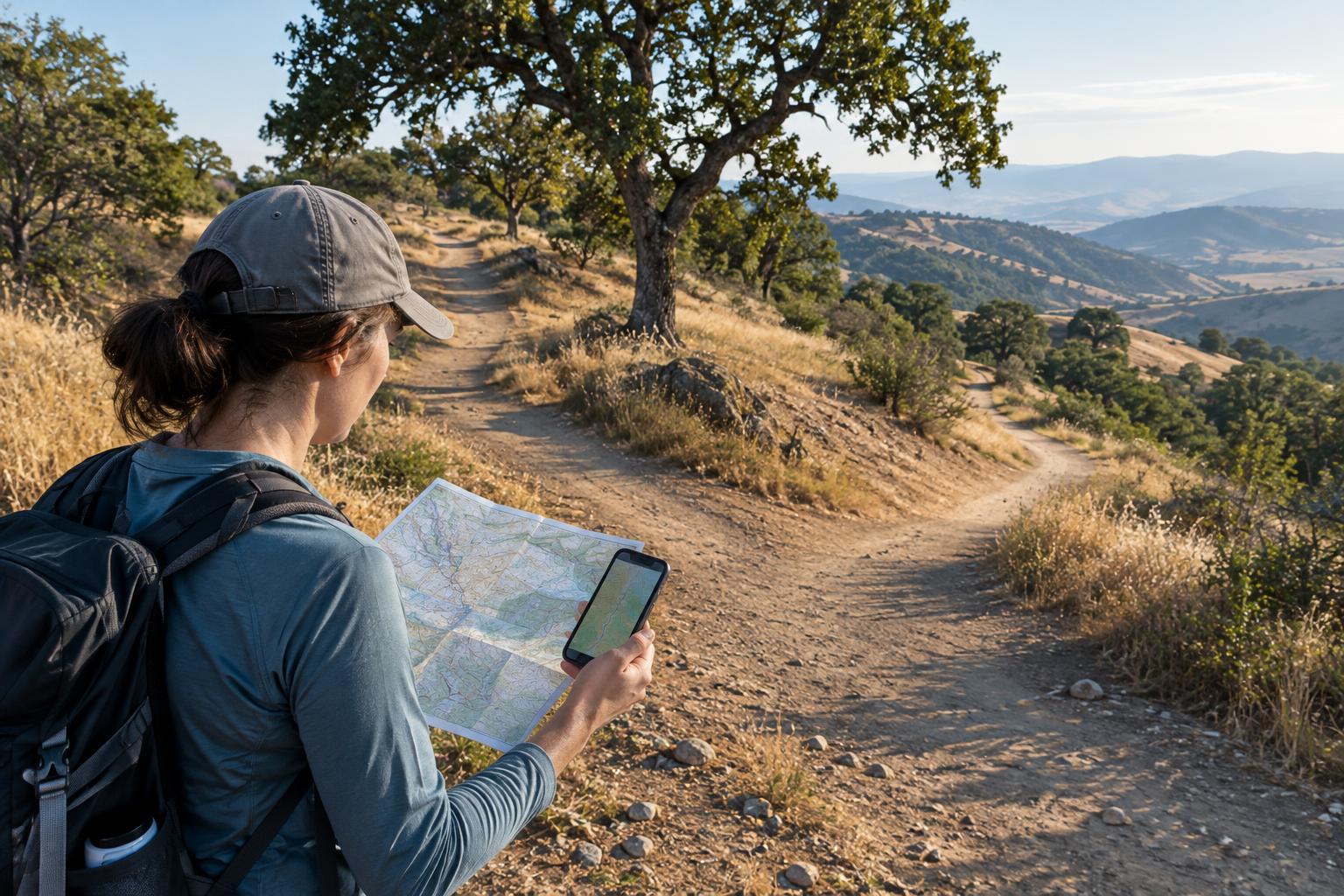
Make the route clear before you leave
A walk near a Central Valley town and a longer outing in the surrounding foothills can feel very different once reception disappears. Before setting out, look at the whole route rather than just the destination. Identify the trailhead, junctions, likely turnaround point and any alternate paths that could lead you away from your starting point. If you are using a public trail, check the information provided for that trail before you go; access and conditions can change.
Tell someone where you plan to start, which route you intend to take and when you expect to check in. Choose a turnaround time as well as a destination. A clear time limit helps when a scenic stop, a slower pace or an uncertain junction makes the original plan less practical.
Give your phone an offline job
Download the relevant map area before you leave home, then open it without a network connection to confirm that it is actually available. Save the trailhead and any important junctions or parking areas. A phone may still determine its location using satellite signals without cell service, but that is not the same as having a usable map: an undownloaded map, a low battery or a poor view of the sky can limit what the screen tells you.
Start with a charged phone and carry a power source if the outing warrants one. Keep the device protected from heat and use its battery deliberately. Offline navigation is most useful when you glance at it at decision points, not when you wait until you are unsure where you are. If you plan to change connectivity or power settings, test how your map and location display behave before the hike.
Carry a backup you can read
For a short, well-marked walk, a printed route map may be a useful backup. For a longer or more complicated route, bring a map that shows the surrounding area and a compass, and learn the basics of using them before you depend on them. A paper map will not show your position automatically. Its value is that it lets you compare the landscape, trail intersections and direction of travel even if your phone fails.
Pay attention as you walk. Notice signed junctions, creek crossings, changes in slope and distinctive bends in the route. At each junction, pause to match what you see with your map before continuing. Looking back after a turn can also help: the same intersection may appear unfamiliar from the direction you will approach on your return. Do not treat informal paths or stone piles as reliable markers of an official route.
Use decision points, not guesswork
When a trail becomes faint or splits unexpectedly, stop where you are. Check the map, your last confirmed location and the direction from which you arrived. If the route still does not make sense, going back to a known junction is often more useful than pressing ahead and hoping the trail becomes obvious. Avoid shortcuts across unfamiliar ground, particularly when you cannot see where they lead.
Set simple limits in advance: turn around if you miss a key landmark, cannot confirm a junction or reach your turnaround time. These choices may feel conservative on a pleasant day, but they leave more daylight and energy for the return. If you are with others, make the decision together and keep the group in one place rather than sending people down separate paths.
If you lose the route, slow down
If you cannot identify where you are, pause, take a breath and check what you know for certain. Can you safely retrace your steps to the last confirmed point? If not, avoid wandering in search of a signal or a view. Stay together, conserve battery and make yourself easier to find. Use any available connection to contact emergency services if someone is injured or you need help; do not assume a call or message will go through without reception.
The best navigation habit is modest: check often enough that you always know the last place you were sure of your position. With a prepared route, an offline map, a backup and a willingness to turn back, a fading signal becomes a manageable part of the outing rather than the moment your plan falls apart.