Set up a steady workspace
Good knife work begins with a board that stays put. Choose a cutting board large enough to hold both the vegetable and a small pile of finished pieces. Place it on a level counter, with room to move your knife without reaching over other ingredients. If the board slides, put a clean, slightly damp kitchen towel beneath it. Keep a bowl nearby for scraps so peels and stems do not crowd your cutting area.
A sharp, well-maintained knife is generally easier to control than a dull one, which may require extra force or slip off a firm vegetable. A chef’s knife suits many everyday jobs, while a smaller paring knife can help with detailed trimming. Use a knife that feels manageable in your hand, and save very hard produce for a tool and method you can control comfortably. Wash vegetables as appropriate, then dry them and your hands before cutting; wet surfaces can be slippery.
Hold the knife and guide the vegetable
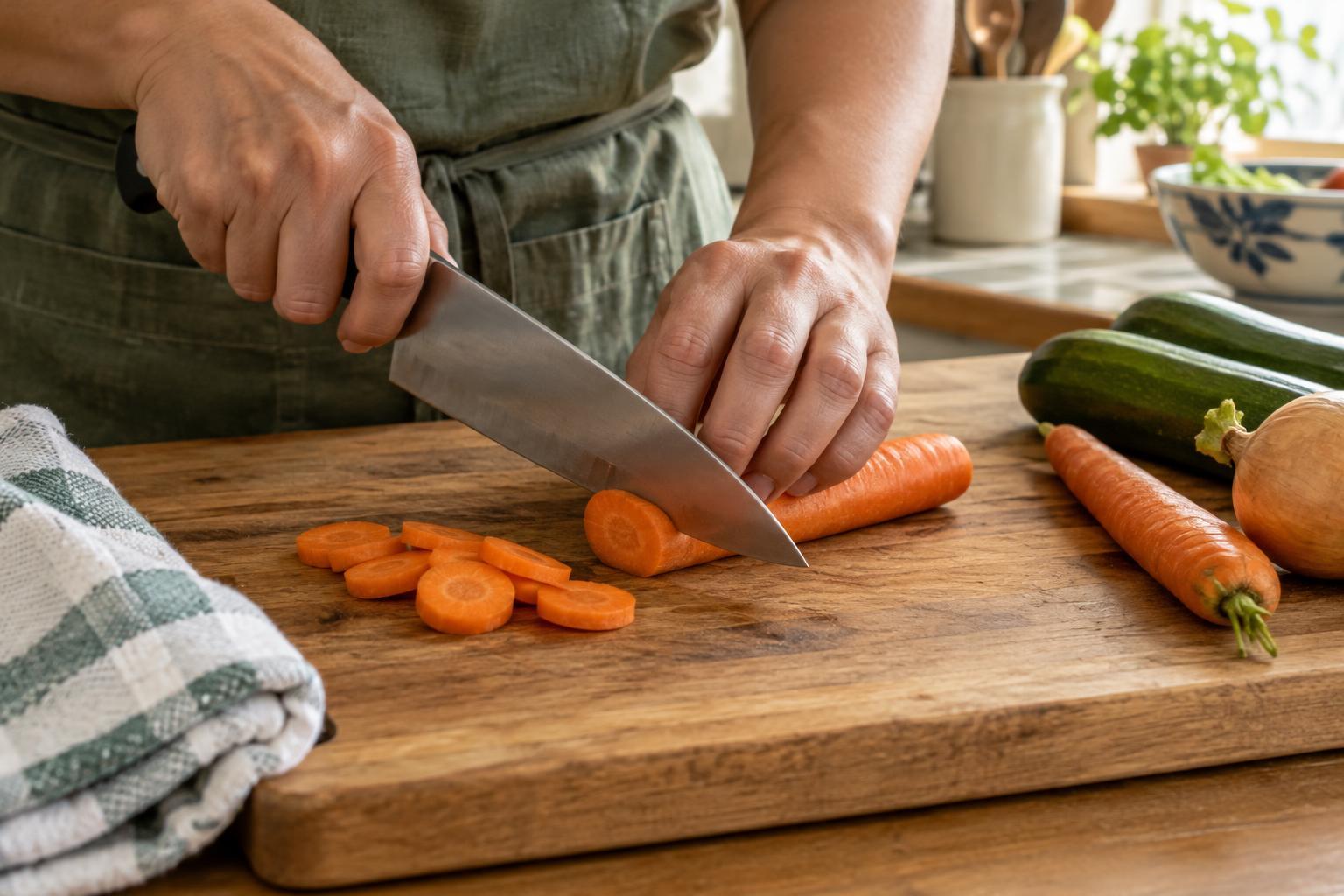
For control, try a pinch grip: hold the blade near the handle between your thumb and the side of your index finger, then wrap your remaining fingers around the handle. You do not need to squeeze hard. Let the knife move in a deliberate rhythm rather than forcing it straight down. Keep the tip or another part of the blade in contact with the board when a gentle rocking motion suits the cut.
Your other hand has an equally important job. Curl its fingertips inward so the knuckles face the side of the blade, and use that hand to guide the vegetable as you cut. Keep your thumb behind your fingers, not stretched toward the knife. Work slowly until the movement feels familiar. It is fine to pause, set the knife down and reposition the vegetable whenever your grip becomes awkward.
Create a flat side before cutting
Round vegetables can roll under a knife. Make them steadier by cutting a small piece from one side, when practical, then placing that flat surface against the board. For an onion, remove the stem end, cut it through the root from top to bottom and set each half cut-side down before peeling and slicing. Keeping the root end attached while making initial cuts can help hold the layers together.
Long vegetables need similar attention. Cut a zucchini or cucumber into shorter lengths if that makes it easier to handle, then halve a piece lengthwise and rest it on its cut side. For carrots, a thin lengthwise slice can provide a stable base before you cut sticks or rounds. If a piece becomes too small to hold safely, stop trying to make one more slice. Set it aside for stock or another use, or switch to a more suitable tool.
Choose cuts that suit the dish
Uniform pieces cook at a more similar pace, but they need not look identical. For a quick sauté, thin slices expose more surface to the pan. For a tray of roasted vegetables, larger chunks may be easier to turn and less likely to soften too quickly. Before cutting, picture how the vegetable will be cooked and served; that decision makes the work more purposeful.
Practice one shape at a time. To dice a stable vegetable, cut it into slices, stack only as many as you can control, cut those into strips and turn the strips for the final crosscuts. Keep the guiding hand clear each time you rearrange the pieces. When chopping leafy herbs or greens, gather a small, manageable pile rather than chasing loose leaves around the board. Consistency comes from repetition and attention, not speed.
Keep the routine safe from start to finish
Pay attention to what the blade is doing between cuts. Put the knife down on the board when you need to clear space, and move chopped vegetables with a bench scraper or the back of the blade rather than dragging the sharp edge across the board. Never try to catch a falling knife. If someone joins you at the counter, pause before turning or passing a knife.
Clean as you go, especially after handling ingredients that call for separate food-safety precautions. Wash and dry the knife carefully, with the sharp edge facing away from your hand, and do not leave it hidden in a sink of soapy water. Once the board is clear and the knife is stored safely, vegetable prep becomes easier to repeat: a stable surface, a comfortable grip and unhurried cuts can carry you through anything from weeknight soup to a platter of sliced local produce.