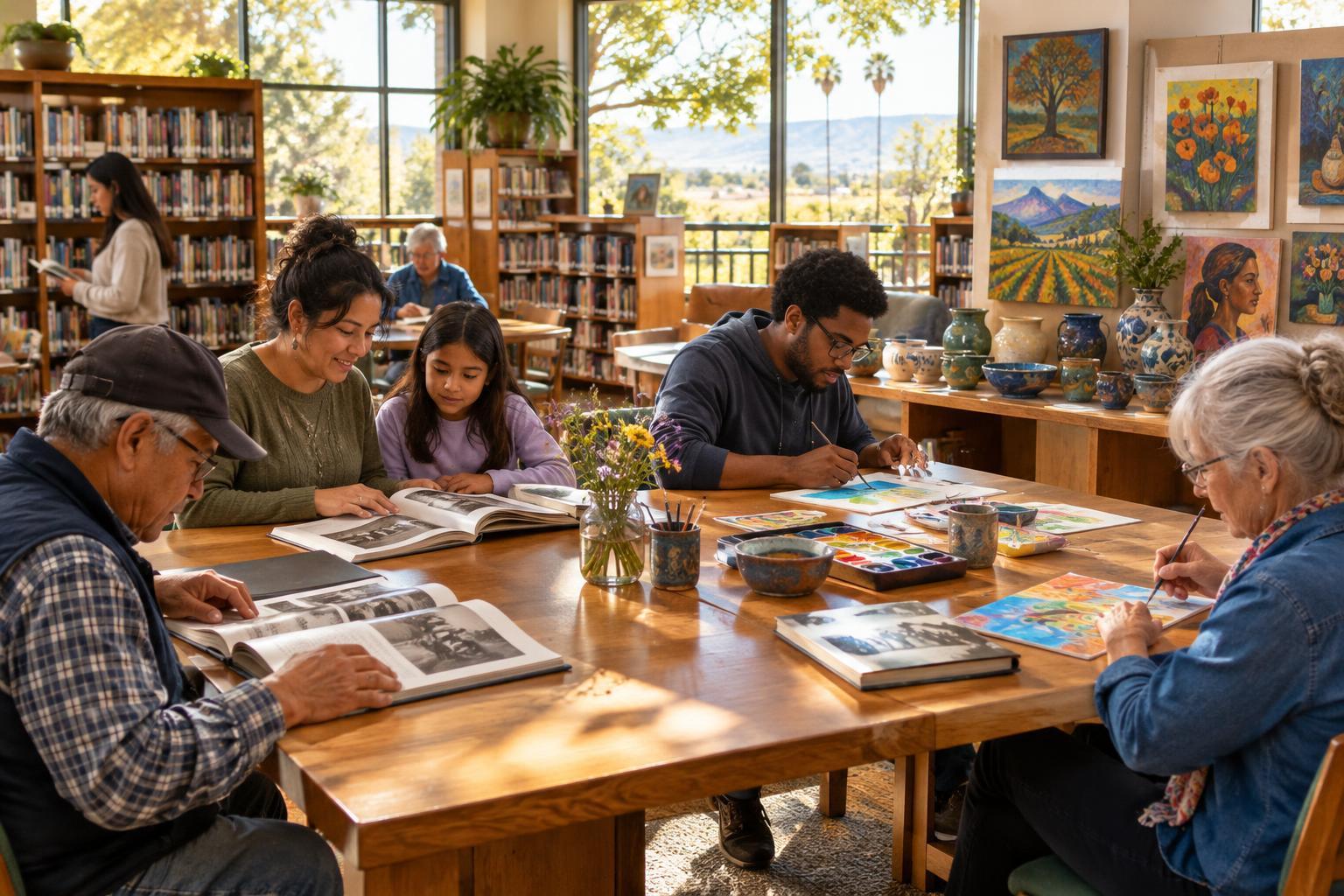
A starting point for local stories
The Central Valley holds many stories: those of families who have lived here for generations, people who arrived more recently, and communities shaped by farming, work, food, music and art. A library offers a place to encounter those stories without needing to know where to begin. A reader might find a book by a regional writer, a cookbook that reflects a familiar kitchen, or a photograph that prompts a conversation about how a neighborhood has changed.
Local-history collections vary from branch to branch, so it is worth asking a librarian what is available. Some libraries may have newspapers, oral histories, maps or other materials that help residents explore their area. Others may be able to point visitors toward a larger collection elsewhere in the library system. Even a small display of books on regional subjects can open a door to a deeper understanding of home.
A welcoming place to encounter art
Not everyone first meets an artist in a gallery or theater. A drawing displayed near the library entrance, a poem read aloud at an event, or a book selected for a community discussion can make creative work part of an ordinary day. When a library hosts an exhibit, performance or workshop, it gives people a low-pressure way to try something unfamiliar. Visitors can come for a book and leave with a new artist or idea to explore.
Opportunities depend on the library's space, staff and schedule. Rather than assuming a particular program is offered, check a branch calendar or ask what is planned. If you make art yourself, ask whether there is a process for proposing a display, reading or class. A clear, modest proposal that explains what visitors would experience is a useful starting point.
Room for making things together
Libraries can support culture by giving people space to participate, not just observe. A craft gathering, writing group or family activity invites neighbors to exchange skills and perspectives. The finished object may be a short story, a sketch or a handmade card, but the conversation around it matters too. People who might not otherwise meet can discover a shared interest across ages and backgrounds.
A visitor does not need to arrive with expertise. Try attending a beginner-friendly event, borrowing a book about a craft, or asking staff where to find materials for a project. If your local branch does not offer the activity you have in mind, ask whether it knows of a community group or another branch that does. Libraries often serve as useful guides to resources beyond their own walls.
Connections among neighbors and creators
Arts communities grow through repeated, everyday contact. A public reading can introduce an audience to a writer. A discussion group can give people a reason to talk about a book they might have read alone. A library noticeboard or event listing, where available, may help residents discover other creative gatherings. These are small connections, but they can make cultural life feel more accessible.
Libraries also provide a setting where people can listen before they speak. A thoughtful discussion of a novel, family recipe or local photograph can reveal different experiences of the same place. Approaching those exchanges with curiosity makes room for stories that are easy to miss when we talk about the Valley as though it has only one identity.
How to take part
Start with the branch closest to your regular routine. Browse its shelves and displays, look for an events calendar, and ask a librarian one specific question: Are there local authors to read? Is there a collection about this town? Are there activities for someone interested in drawing or storytelling? Specific questions make it easier for staff to suggest a useful next step, even if the answer is at another branch.
You can support local arts and culture simply by showing up and engaging respectfully. Attend an event that interests you, recommend a regional book to a friend, or bring a family member to explore the collection. If you have an idea for a program, learn what the library can accommodate before making plans. The value of a library is not only what it holds on its shelves, but what neighbors can discover and share there together.