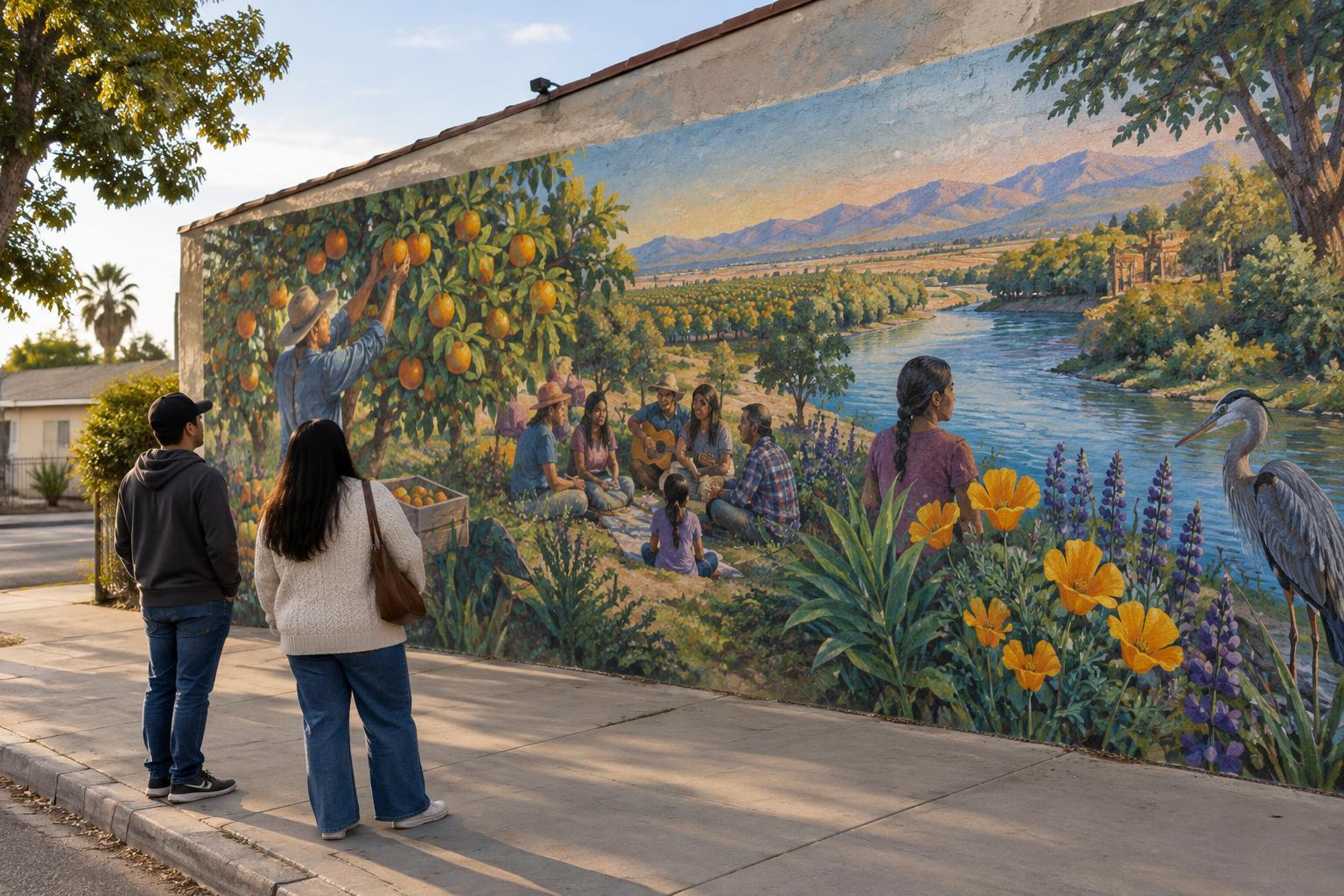
Begin with what you can see
A mural may catch your eye on the way to a market, a park or a community event. Before deciding what it means, pause with the visible details. What figures, plants, objects or patterns appear? Which colors draw your attention first? Does the image move across the wall as one scene, or does it bring several smaller scenes together? Describing these choices gives you a starting point without assuming you know the artist’s intent.
Take in the whole setting, too. Notice the mural’s size, the shape of the wall and where a passerby would first encounter it. A design meant to be seen from across a street may read differently when you stand nearby. If you can do so safely and without blocking a walkway, look from more than one distance. Details that seem decorative at first may connect parts of the composition.
Look for themes without forcing one interpretation
Public murals often make room for more than one reading. An orchard, a river or a shared table might suggest work, memory, gathering or a relationship with the landscape. In a Central Valley community, those images may feel familiar, but familiarity is not proof of a particular message. Ask how the images relate to one another: Is someone tending, carrying, celebrating or resting? What seems to be emphasized, and what remains open-ended?
It helps to separate observation from interpretation. “There are three figures beside a row of trees” describes what you see. “This is about family history” is a possible reading. That distinction makes it easier to talk with someone who notices something different. You can enjoy a mural’s mood without settling every symbol into a single explanation.
Find context close to the wall
A title, artist signature or nearby plaque may offer clues about the work. You might also find information from the group that organized it or the public space where it appears. If that information is available, note the artist’s own words and the names of collaborators before relying on guesses about what the mural represents. A work can respond to a place, a commission or a community conversation that is not visible in the paint alone.
Context also includes the wall’s everyday life. Is the mural beside a school route, a gathering space or a busy commercial block? Who can readily see it, and at what pace? These questions do not reveal everyone’s experience of the work, but they can deepen your attention to its public setting. If you want to learn more, stay open to accounts from residents and participants while recognizing that no one person speaks for an entire neighborhood.
Give credit with care
If you photograph or write about a mural, identify its maker when you can. Look for a legible signature or reliable information at the site, and check whether other artists, assistants or community groups are named. Use the artist’s preferred name if it is available. If you cannot confirm an attribution, it is better to say so than to assign credit based on a social media guess.
Credit is more useful when it stays connected to the work. A caption can include the artist’s name, the mural’s title if known and a general location that helps readers understand the setting. Before sharing images commercially or reproducing artwork beyond an ordinary personal post, consider whether you need the artist’s permission. Be mindful of people who happen to be nearby: a clear mural photograph does not require turning strangers into its subjects.
Let the conversation continue
You do not need an art-history vocabulary to respond thoughtfully to a mural. Try asking a companion what they noticed first, which part they would revisit and what questions the image raised. Different answers can open a conversation rather than a contest over the “right” reading. If an element is unfamiliar, curiosity is a better starting point than a confident explanation.
A mural is part of a place people continue to use after you walk away. Enjoy it without touching or altering the surface, and leave room for local perspectives on its meaning. The most rewarding way to read public art is often simple: look carefully, seek context, name the people behind the work and remain willing to notice something new the next time you pass.