Start with what you notice
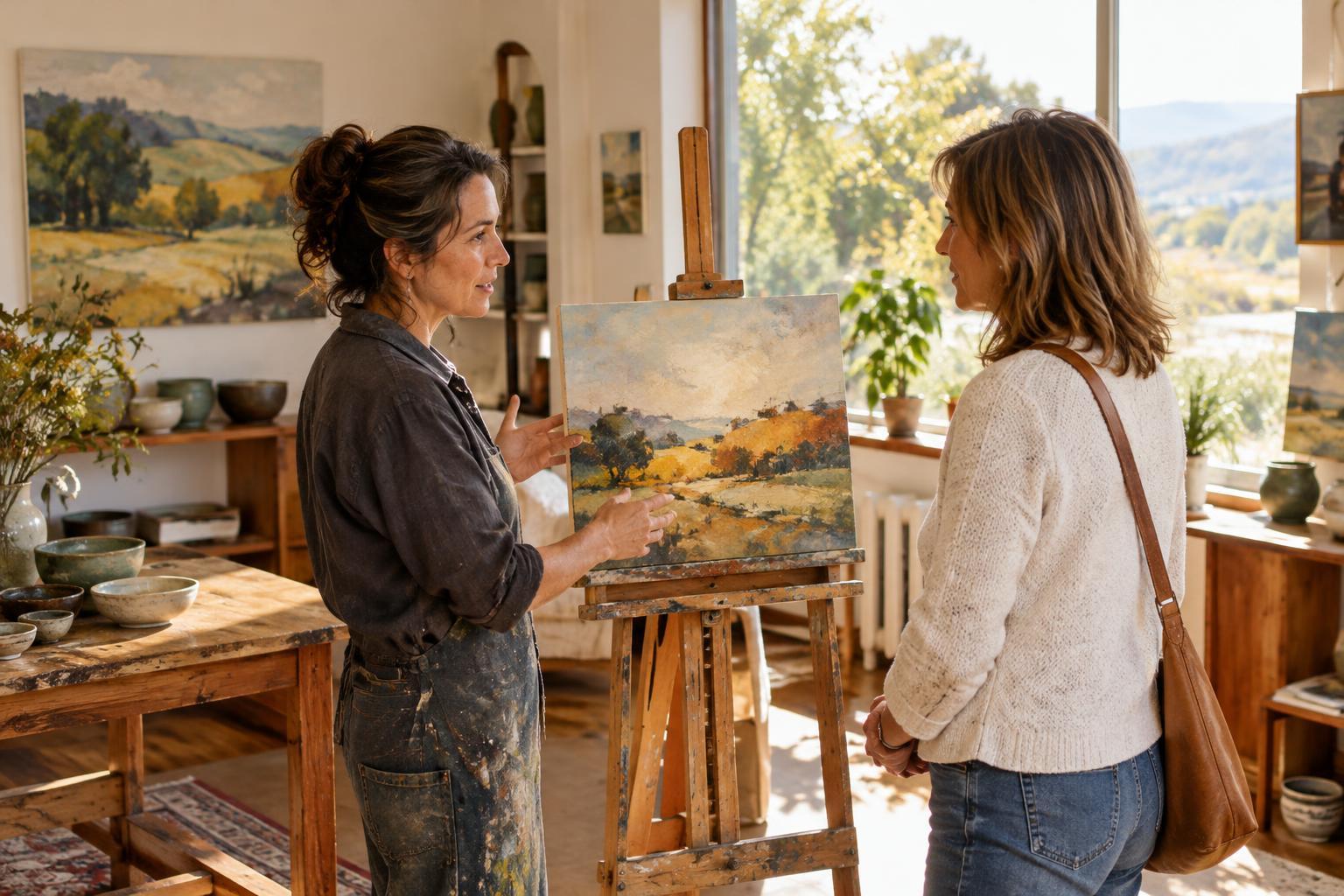
At a gallery, art market or community event, it can be tempting to open with an interpretation: “This must be about growing up here,” or “You’re clearly inspired by the landscape.” You may be right, but you have already narrowed the conversation. A more generous opening names something you can observe and invites the artist to take it from there. Try “I keep coming back to these colors. How did you choose them?” or “What would you like people to notice first?”
You do not need specialized vocabulary to have a worthwhile exchange. Questions about materials, process, scale or a detail that caught your eye give an artist room to explain what matters to them. In a region as varied as California’s Central Valley, local work may draw on place, family, imagination, technique or none of those in an obvious way. Let the artist tell you which connections are meaningful.
Ask about the work before the biography
An artist may welcome questions about their background. They may also prefer to talk about a painting, photograph, ceramic piece or performance on its own terms. Begin with the work: “What were you experimenting with here?” or “How did this piece change while you were making it?” If the artist brings up personal history, you can follow their lead without treating it as an explanation they owe you.
Be especially careful with questions that assign someone a role before they have chosen it. “Are you speaking for your community?” places a large expectation on one person; “Does your connection to this place play a part in your work?” leaves room for yes, no or a more complicated answer. The goal is not to avoid identity or place. It is to avoid deciding what they mean on the artist’s behalf.
Make room for answers you did not expect
Good questions can be short, and good listening often means resisting the urge to fill every pause. An artist might give a technical answer when you expected an emotional one, or describe a playful choice you thought was symbolic. Instead of defending your first reading, try “I hadn’t thought of it that way” or “What led you to that approach?” Your interpretation can still matter to you without becoming a test the artist has to pass.
If you want to share a personal response, frame it as yours: “This reminds me of evenings outdoors,” rather than “This is about summer evenings.” That small shift makes conversation possible without claiming authority over the work. It also lets an artist respond freely—by finding a connection, offering a different perspective or simply thanking you for looking closely.
Respect the setting and the artist’s time
A quiet exhibition opening may allow for a longer exchange than a busy booth where the artist is greeting visitors and handling sales. Notice whether others are waiting, and keep your first question manageable. If you would like to ask more, “Is this a good time to talk about the piece?” gives the artist an easy way to set a boundary. A brief, attentive conversation is often better than one that holds up their work.
Permission matters beyond conversation, too. Ask before photographing an artist or their work, and check before posting images or tagging them. If a piece is for sale, it is fine to ask about its price or how to purchase it; you do not need to disguise that interest as a discussion of meaning. If you are not buying, genuine attention and a courteous thank-you are still appropriate.
Leave the conversation open
You will not always find the perfect question, and an artist will not always want to explain a piece. That is okay. You can say what drew you over, listen to what they choose to share and let the exchange end naturally. If you realize you made an assumption, a simple “Thanks for correcting me” does more good than a long defense of what you meant.
Talking with local artists is one way to become more attentive to the creative life around you, whether you are visiting a neighborhood show or browsing work at an outdoor event. Approach each person as an individual making deliberate choices, not as a shortcut to understanding an entire place. Curiosity, patience and respect give both the artwork and its maker more room to be surprising.